Appalachian Murder Ballads, Oral Tradition, and Femicid
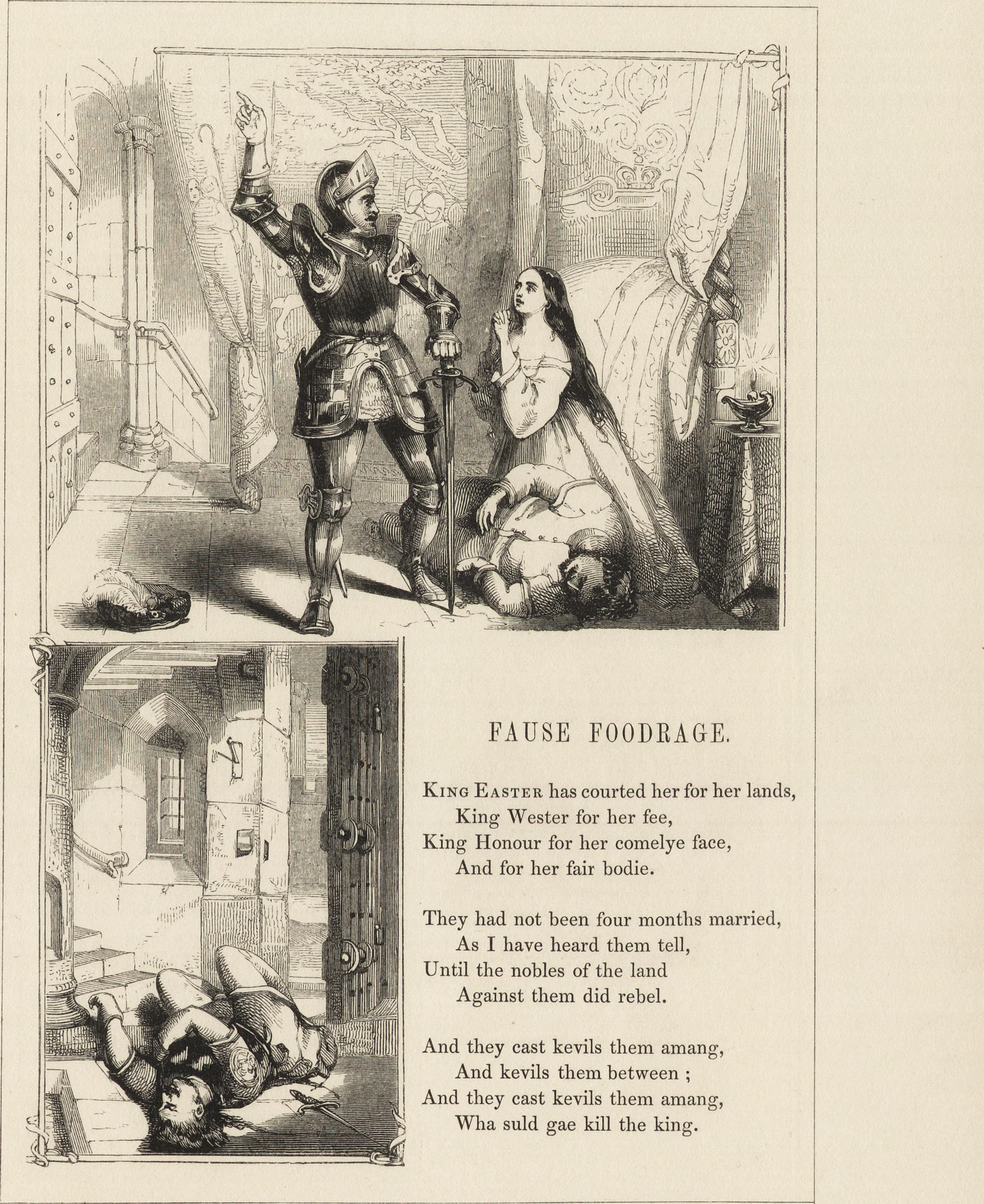
Fause Foodrage, a Scottish murder ballad written in the 17th century. First printed in 1802 by Walter Scott but is supposedly originally written by Elizabeth, Lady Wardlaw. This page is from The Book of British Ballads, printed 1842.
When one hears the term “murder ballad” it’s pretty easy to understand just based on the term alone. It's a sub genre of traditional folk music that tells a narrative story, a ballad, but the story is about the murder of one or more people, sometimes told from the perspective of the victim, the perpetrator(s), or an unnamed third party acting as a narrator. Interestingly, the murderer is portrayed as sympathetic on occasion in the narrative. Like many Appalachian music traditions, the murder ballad originates from the British isles, most notably Ireland and Scotland, before crossing over to the United States along with the immigrants and their traditions. The Cuckoo and House Carpenter (also known as The Daemon Lover) are notable examples of this.
In the realm of strictly murder ballads, Knoxville Girl falls into this category of songs that came from the British isles and came with the people’s transition to the United states, the first waves of these immigrants coming in the late 1700s and early 1800s. Originally titled Wexford Girl, it tells the story of Anne Nichols, a young woman who was murdered in 1683 near Shrewsbury, in a town then known as Salop by a man named Francis Cooper. How the story goes is that Nichols sleeps with Cooper, and when she discovers she’s pregnant, she tells her father, who says she must convince Cooper to marry her. Cooper tells her to meet up with him in a secluded area to talk the matter over and he murders her. First known documentation of this in song, is The Bloody Miller. The much more well known song, Wexford Girl, would be adapted from this retelling of events much later.
Of course, not all songs of Appalachia are from Ireland and Scotland, other famous examples of original American murder ballads are Tom Dooley, Omie Wise, and Stagger Lee (or alternatively Stagolee). These tell the story of Tom Dula, Naomi Wise, and Lee Shelton.
In Tom Dooley, Tom is set to hang for stabbing a woman to death, Laura Foster. As the story goes, Tom Dula was in a relationship with Anna Foster, Laura’s cousin, while still pursuing Laura and another woman in their family Pauline Foster. Some stories frame Anna as the one that killed Laura out of jealousy, some depict Dula as killing Laura because she was pregnant, but in truth, Pauline testified against the two, Anna was acquitted and Tom Dula was hanged in 1868. He was buried in Ferguson, North Carolina.
The details are always up for debate and change constantly in stories that recount Lee “Stack Lee” Shelton and how he killed William Lyons in a tavern. In some songs he’s cruel and violent, killing the bartender and killing Lyons for seemingly no reason, and in others he’s portrayed as innocent and acted out after being wronged first. Sources that recount the incident confirm that it happened in a bar, the two had an argument, Lyons stole Shelton’s prized Stetson hat and in retaliation, he shot Lyons. He left the bar that night and Lyons died from his injuries. Shelton was arrested for murder and later died in prison in 1912 and is buried in Hillsdale, Missouri.
Common renditions in the story of Naomi Wise depict her as an orphan girl who was raised by a farmer couple and worked for them as a cook and field hand. According to legend she fell in love with a mysterious man named Jonathan Lewis in 1807, but broke her heart when his mother learned of their relationship and pushed him to court Hattie Elliot instead. When the news of his previous relationship reached her, Elliot confronted Lewis and accused him of being unfaithful. Unfortunately for Naomi Wise, she was pregnant and Jonathan Lewis, concerned how this would affect his future with Hattie Elliot, convinced her to meet with him privately where he then beat and drowned her. Jonathan Lewis eluded any murder trial or proper punishment for her death and was free for the rest of his life. Naomi Wise is buried in Randolph County, North Carolina.
Something about these examples that could be obvious, is the documentation of these cases being inconsistent, wrong, or have key details missing altogether along with how many variations there are of essentially the same story. This is in part of how old many of these cases are, but also we’re frankly lucky documentation exists at all due to the rural and remote nature of Appalachia and the people that inhabit the region. For many years in the Appalachia region, their music was essentially a form of journalism that was recited for decades, as illiteracy rates were higher than average and many newspapers didn’t get through to some of the regions in the mountains. This shows in how the songs were not often written down and were passed orally for generations. This is reflected in a lot of Appalachian folk songs having different versions and contradictory interpretations and lyrics as they were just sung by memory. Even Wexford Girl has this treatment, having small altercations with songs written afterwards inspired by the initial event that are often confused with the original, mixing fact with fiction. This includes songs such as The Berkshire Tragedy, The Wittham Miller, Hanged I Shall Be, and some others. This changed with the massive effort to transcribe and archive the music in the 1910s and 1920s.
In the case with many murder ballads, it’s very common that they’re written about a woman who was killed by their lover, unwanted pregnancy often being a factor in their murder.
There’s a misogynistic undertone of songs that look down on the sexual freedom of women and the fact that the pregnancy belonging to an unwed woman is shameful to her community and/or her lover. The beauty and naivety of these women are often highlighted in these song lyrics and titles themselves, linking it with impending disaster and the fact that their murderers are often portrayed as sympathetic or as a victim in their own right in the lyrics. Only killing the women in question if their actions threaten their masculine honor and social reputation, or out of uncontrolled emotion as a crime of passion. Writer Cristinia Ruth Hastie describes the way the women are written in these songs as some sort of “anti-ideal woman”. One who is trusting, innocent, loved by her family, who were tempted into illicit sexual behavior due to their foolishness, despite what actual historical evidence may say otherwise, her agency removed from the narrative.
Some modern writers notice that another common theme in the women’s disposal is them being left in the lake or river, an allegorical act of both killing the woman, but also cleansing in christian mythology. Writer J. Roberta Coffelt comments on the underlying gendering of drowning, “prior to about 1920, women often did not know how to swim—while boys might have been welcome to splash and swim in lakes and ponds, girls typically were not.” and “Drowning is associated with women because of the link between female sexuality and liquid via the egress of menstrual blood and breast milk and the intake of semen. Further, water and that ubiquitous symbol of femininity, the moon, are linked via tides” in her own essay She “Too Much of Water Hast” Drownings and Near Drownings in Twentieth-Century North American Literature By Women as to why water and riversides are common in these stories and why drowning in particular was common end for a woman with atypical expression of sexuality.
While the original objective of the songs was to document the past, highlighting the vulnerability women had in rural communities, it's not an uncommon sentiment that part of the reason there was a renewed interest in preserving murder ballads is to possibly send a message to women and what could happen to them if they “misbehave” or act out in ways considered unconventional. The 1910s and 1920s were times of great change, both social and industrial. New machines designed to make one's life easier, more abstract and surreal art, political tension with ww1 around the corner, and change in relation to communities that hold tradition dear can be a source of interpersonal tension as well.
Around the 1940s, female songwriters took this understanding of the murder ballad into their own hands and there was an effort of portraying women and their representation in the songs as more cunning and overtly dangerous instead of disposable ingénues doomed to a watery grave. Wanda Jackson and Patsy Montana in particular wrote songs where the female main character, after being wronged by their lover, kills them instead. These songs being I Didn’t Know the Gun was Loaded in 1949 and The Box It Came In in 1966. Dolly Parton herself has made multiple albums in the 1960s that focus on the lives of women in specific, sometimes being abused by men but not having to die for it. In her career she covered many original ballads herself such as Silver Dagger and Banks of Ohio as the ballads were and still are cornerstones of the country genre. Dolly Parton even wrote a murder ballad of her own, The Bridge, where the woman dies at the end as expected, but instead dies by suicide instead of by her partner.
In the 21st century, the concept of the murder ballad is still going strong, still considered classics of the genre and covered extremely often by country music stars both young and old.
The concept of a modern murder ballad extends far past Appalachia even though they’re still strongly associated with that region’s history. Part of this enduring interest of the murder ballad and it inspiring work in the present could be in part due to America’s fascination with true crime and the violence humans are capable of, while still wanting to honor the memory of the mountains and people that resided in them. Nick Cave of Nick Cave and the Bad Seeds wrote an album in 1996 called Murder Ballads, which as one would expect, has many original ballads in it (Curse of Millhaven) along with covers of classics (Stagger Lee). Violent Femmes’s Country Death Song also works with the murder ballad formula, even having the confusion over if it was based on a true story or not (it’s not) and could be considered a modern classic in the genre with its commercial success.
It feels comparatively rare for a genre of music to be this old, this diverse, and still this well known in the modern age. Even for someone who would consider themself more than a casual enjoyer of the genre, it feels incredibly daunting to even begin summarizing and explaining the hold it still has over not only people from the southeast, but anyone with either an interest in music history, or loves the storytelling structure within music. It's a deep honor to me that we have records of the people from its past still being kept alive today, not only through music but due to the fact that songs about these people at all are remembered and have had historians make effort to keep track of ordinary people in the mountains that lived, loved, and killed, because of the records kept around by their peers.
Hogg, K. (2020, March 17). The history of murder ballads and the women who flipped the script. She Shreds Media. https://sheshreds.com/the-history-of-murder-ballads/
Gomez, K. (2023, October 25). The murder of Naomi Wise. The Forgotten South. https://theforgottensouth.com/the-murder-of-naomi-wise/
Jordan, W. (2026, July 12). Inside the world of the Appalachian song catchers. BlueRidgeTales. https://blueridgetales.com/inside-the-world-of-the-appalachian-song-catchers/
Slade, P. (2013). Planetslade.com. Murder Ballads | Paul Slade - Journalist. https://www.planetslade.com/murder.html
Hastie, C. R. (2011, August 1). “This murder done”: Misogyny, femicide, and modernity in 19th-century Appalachian Murder ballads. TRACE Angular. https://trace.tennessee.edu/entities/publication/7350d1e0-3d08-40e1-ad27-e4beab8da75c
J. (2025, December 15). Appalachian Murder Ballads: An overview. WKNC 88.1 FM - North Carolina State University Student Radio. https://wknc.org/2024/01/20/appalachian-murder-ballads-an-overview/
Flannery, E. (2025, May 1). Momuno: A banjo and a body: Appalachian murder ballads and the American fascination with true crime. Missouri Music Notes. https://missourimusicnotes.blogspot.com/2025/05/a-banjo-and-body-appalachian-murder.html