
Hee Haw (1969-1997) and the New Country
From the 70s to the late 90s, Hee Haw aired on tv and continues to be one of the most influential hosts of sketch comedy that blended country music into its regular programming.
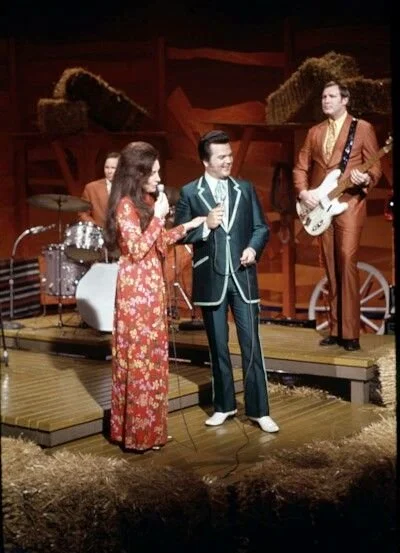
Loretta Lynn and Conway Twitty on the set of Hee Haw in 1972. Fun fact! Loretta Lynn was the first musical guest on Hee Haw’s debut in 1969 and appeared about 24 separate times in its entire run!
Taking a step back, it’s important to remember the origins of country music and how it was seen by outsiders to the genre.
For a very long time, country music had the reputation of being music made for and by “poor and uneducated rednecks”.
This common mentality around country music is born from the regions and peoples country was founded by and how they were seen by wider society. It’s important to understand that country music as we know it has complex origins akin to a hodgepodge made up primarily of folk songs and instruments brought to the United States by enslaved black people, immigrants of mostly Scottish and Irish descent, blues music, minstrel songs, and other elements that fall under these slightly more broad categories. Needless to say, these building blocks as well as the lived experiences of these people are noticeable in many early songs that would fall under what would eventually be categorized under the label of country. Pains of working class struggle, prison life, inequality, death, poverty, and other common themes such as these are common among many early songs written by what would be later recognizable as early founders of the genre.
To properly document and categorize the origins of country music in this writing, and when it even would be accurately categorized as “country,” would require much more time and space to write than would be necessary for a writing focused on the tv show Hee Haw. So for the sake of this article, we will put a pin in this and investigate in later articles on country music history.
In the late 40s and 50s there was a massive effort by record labels to drop the current label this type of music had, “hillbilly music”, and shift towards calling it “country and western”. Many singers from this era wore more flashy and decorated outfits while performing, decorated cowboy boots and hats were to romanticize the genre and appear more refined and sophisticated while still in the country music industry. Part of the motivation for this rebrand was the rising popularity of rock music, RnB and other newer music genres. This also resulted in the invention of the rockabilly genre of music, blending the styles of country and rock together as a fight for relevance.
Hee Haw was distinctively different in terms of presenting the genre to the public.
Modeled after the hit variety show Laugh-In, executives of the network chose country singers Buck Owens and Roy Clark to host the show to attract more high profile singers to take interest in the program. Set in the fictional farming community called Kornfield Kounty, It was dedicated to maintaining a rural atmosphere and unserious nature in its production.
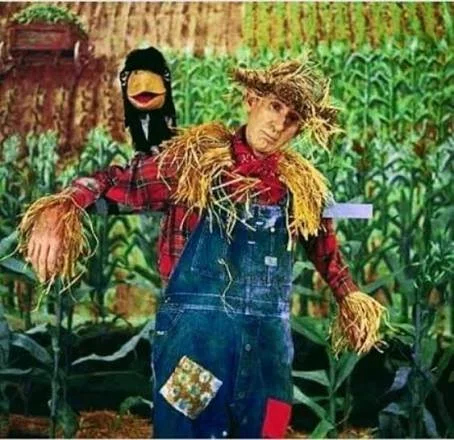
Cast member David Akeman, better known on the show as Stringbean, often played the scarecrow in the cornfield skits and contributed to the jokes often. Stringbean passed away in 1973 and the scarecrow remained in the background of many cornfield segments as a tribute to him.
Early reviews of the show were decidedly extremely harsh, some highlights being “the most irrelevant, stupid, and ghastly program in recent history.” From the Los Angeles Times after the first episode aired in 1969. Others, like the Houston Chronicle called it “Possibly the worst show I’ve ever seen.” and “Anyone who would watch ‘Hee Haw’ doesn’t deserve to own a television set,” from the Toronto Star. Despite this, its appeal and marketability grew and was not regulated to just people that were already fans of the genre or a rural southern market as it was intended to be, but was widely successful in multiple cities all across the states, including New York, Chicago and Los Angeles.
Hee Haw had many notable guests on its program, including already famous country stars like Loretta Lynn, Tammy Wynette, and George Jones.
Hee Haw also was known for having many talented people on the regular cast who would become stars in their own right such as Minnie Pearl, Stringbean, Grandpa Jones, and their own band the Hee Haw Gospel Quartet. Part of the appeal of Hee Haw was its particular blend of comedy skits and music, a connection that lasts to this day. One of the most famous recurring gags was “Cornfield bits” where they would tell one liners in a cornfield set and usually in farmer costumes, but they had others as well such as KORN news (in which cast member Don Harron would play his character, Charlie Farquharson, and report the news on residents of Kornfield Kounty with plentiful double entendres), Pickin’ and Grinnin’ (a reoccurring skit where Roy Clark and Buck Owens would sit with the rest of the cast, play music and tell jokes in between the verses), Junior Samples used car sales (Cast member Junior Samples would parody salesmen commercials and attempt to sell obviously broken down cars to the audience while holding up the company phone number BR-549), and much more.
Unfortunately for Hee Haw, it was a part of CBS’s mass rural purge of 1970-1971 in effort to make room for new shows to target younger and more urban audiences. Despite its strong ratings, Hee Haw was canceled along with other programs on CBS that had a similar style such as The Beverly Hillbillies, Green Acres, and Mayberry R.F.D. It retained its audience after its shift to airing on TNN but was cancelled for good in 1997 because of new network ownership.
With Hee Haw being off the air for decades now, it may be debated among modern audiences if Hee Haw’s utilization of regional stereotypes was harmful or not.
He used sexist stereotypes as one liners and jokes. A notable example of this that’s often brought up in discussion is the “hee haw honeys”, a nickname given to several female cast members who dressed in scantily clad clothing while performing. Hee Haw was not unique in this, many comedy oriented programming have had this problem, especially in the 60s and 70s when it was at its peak. This aspect is often defended with the fact that the Hee Haw Honeys were accomplished musicians and comedians in their own right and had plentiful opportunities to showcase their talent on the show and their outfits were a part of the parody aspect of the tv show.
Intent and effect of the program’s portrayal of women aside, something I’m more interested in digging into is the relationship between Hee Haw’s demographics and its relationship with country music history. Watching the show, it’s very apparent that Hee Haw had a Majority white cast and guests on the program. With Hee Haw being responsible for broadcasting country music to new audiences, molding a new kind of public perception of the genre, while all being marketed mainly to rural communities that built what country music is, it feels somewhat irresponsible to me. This feeling of mine is intensified knowing that the peak of rural television coincided with the civil rights movement of the 60s and 70s.
It’s a topic I mull over oftentimes how Hee Haw’s intent was clear in parodying and paying a tribute of some sort to the kinds of people that built country music who may have felt estranged from the harsh shift markets made to become more respectable to mainstream audiences.
But also in that same breath, Hee Haw’s objective was comedy and hosting artists, it isn’t the history channel. Having hypothetical black cast members act the same way as their white counterparts, foolish, ignorant, promiscuous (as in the case of the Hee Haw Honeys), and lazy could also be taken as mockery and tasteless, especially in the 70s when more diverse and political programming was coming out such as All In The Family, Mister Roger’s Neighborhood, The Mary Tyler Moore Show, Sanford and Son, and M*A*S*H. Black Americans were starting to be represented as people and not punchlines. Still however, representing black country musicians is essential if one wants to portray country music’s roots and it's a missed opportunity there wasn’t more featured as guest artists.
In terms of representing country music to new widespread recognition and the results of that, for better or for worse, country music as a genre is firmly associated in the current year with rural populations and the southern United States especially. This is accurate, but does not do country music any favors in winning any popularity contests in 2026. Gerrymandering in the South, lack of funding for education for rural communities, and other topics too dense to start talking about in an essay about Hee Haw, add onto this strong negative attitude and classism some people approach the country music genre with. It is not a common genre for people to talk about with love or respect.
Where it counts, I revere Hee Haw and what it did for country music and promoting some of its talents, but to get country music into the public consciousness again will take some major work.
Sources
Edwards, J. (1993, October 7). `hee haw’ has Last laugh track. THE ROANOKE TIMES. https://scholar.lib.vt.edu/VA-news/ROA-Times/issues/1993/rt9310/931007/10150378.htm
HOFSTEDE, DAVID. Hee Haw: 50 Years Later - C&I Maazine, Aug. 2019, www.cowboysindians.com/2019/08/hee-haw-50-years-later/.
“Roy Clark - Country Music Hall of Fame and Museum.” Country Music Hall of Fame, www.countrymusichalloffame.org/hall-of-fame/roy-clark. Accessed 23 July 2026.
“Like a Rhinestone Cowboy: Country Music Style from the 1940’s and beyond.” Fashion2fiber, fashion2fiber.osu.edu/exhibits/show/fashion-and-music/like-a-rhinestone-cowboy--coun. Accessed 23 July 2026.
Kosovsky, Robert. “Seeking the Origins of Country Music in the NYPL Music & Recorded Sound Division.” New York Public Library, 14 Jan. 2020, www.nypl.org/blog/2019/12/19/origins-country-music.
E, Sofia. “National Country Music Month.” Alachua County Library District, 30 Oct. 2025, www.aclib.us/blog/national-country-music-month.
Bayne, B. (2022, June 20). TV’s Rural Craze & the Civil Rights Movement. Roger Ebert. https://www.rogerebert.com/black-writers-week/tvs-rural-craze-and-the-civil-rights-movement